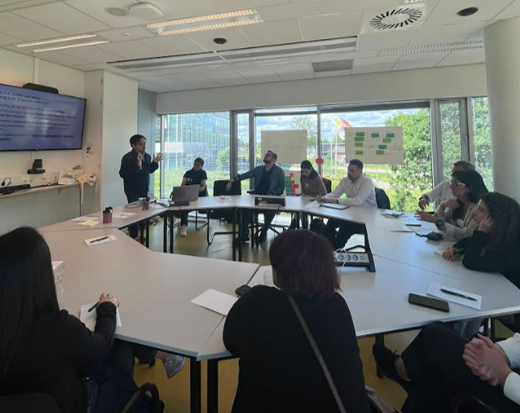



On 9 June 2026, the final round of the HOLiFOOD Living Lab workshops took place in Wageningen, the Netherlands. Two workshops were held in parallel, bringing together 43 people in total.
LL#1 and LL#3 – “Refining the Future of Food Safety: Evaluation & Exploitation Workshop”
The workshop “Refining the Future of Food Safety: Evaluation & Exploitation Workshop” was coordinated by Wageningen Food Safety Research (WFSR) and Agroknow, and organized in collaboration with the Bundesinstitut für Risikobewertung (BfR), the University of Veterinary Medicine Budapest (UVMB), Crème Global, and DIALOGIK, with logistical support provided by the Agency for the Promotion of European Research (APRE).
The workshop aimed to gather participants’ feedback on the latest versions of the models and visualizations developed within the HOLiFOOD project. Following an introduction to the project, an overview of the different model types, and a summary of previous Living Lab activities, participants were divided into four pre-assigned groups, each focusing on a specific tool. Within each group, the corresponding model was presented through the project dashboard, enabling participants to engage directly with tool developers, exchange views, and provide feedback through interactive discussions.
The main findings and key insights emerging from the group discussions were subsequently presented in a plenary session.
A total of 23 participants attended the workshop, representing all components of the quadruple helix: the public sector, academia, industry, and civil society.
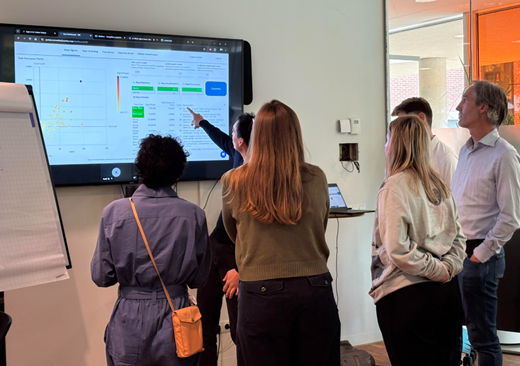
LL#2 – “Resilient value chains: a holistic risk assessment in the era of climate change”
The workshop “Resilient value chains: a holistic risk assessment in the era of climate change” was coordinated by the French National Research Institute for Agriculture, Food and Environment (INRAE), with organizational support from the Agency for the Promotion of European Research (APRE).
The workshop aimed to demonstrate how the co-design approach adopted within the project contributed to shaping both the methodological framework and the results of the holistic assessments. This approach was illustrated through the case studies of poultry and lentil supply chains, providing participants with a comprehensive overview of the assessment process, including the selection of dimensions, impact indicators, metrics, units of measurement, and weighting methods. Participants also had the opportunity to ask questions and seek clarification regarding the methodological choices underpinning the assessments. The final discussion highlighted the added value of involving external experts and stakeholders throughout the holistic assessment process.
The workshop was attended by 20 participants, coming from academia, the public sector, as well as inter-governmental organizations.